Enjoy a free pre-purchase consultation.+971501181300

Lotfi Piano Journal
When you sit down, and place your fingers on the pianos keys, then you will immediately Notice two things you did Not ... Read more
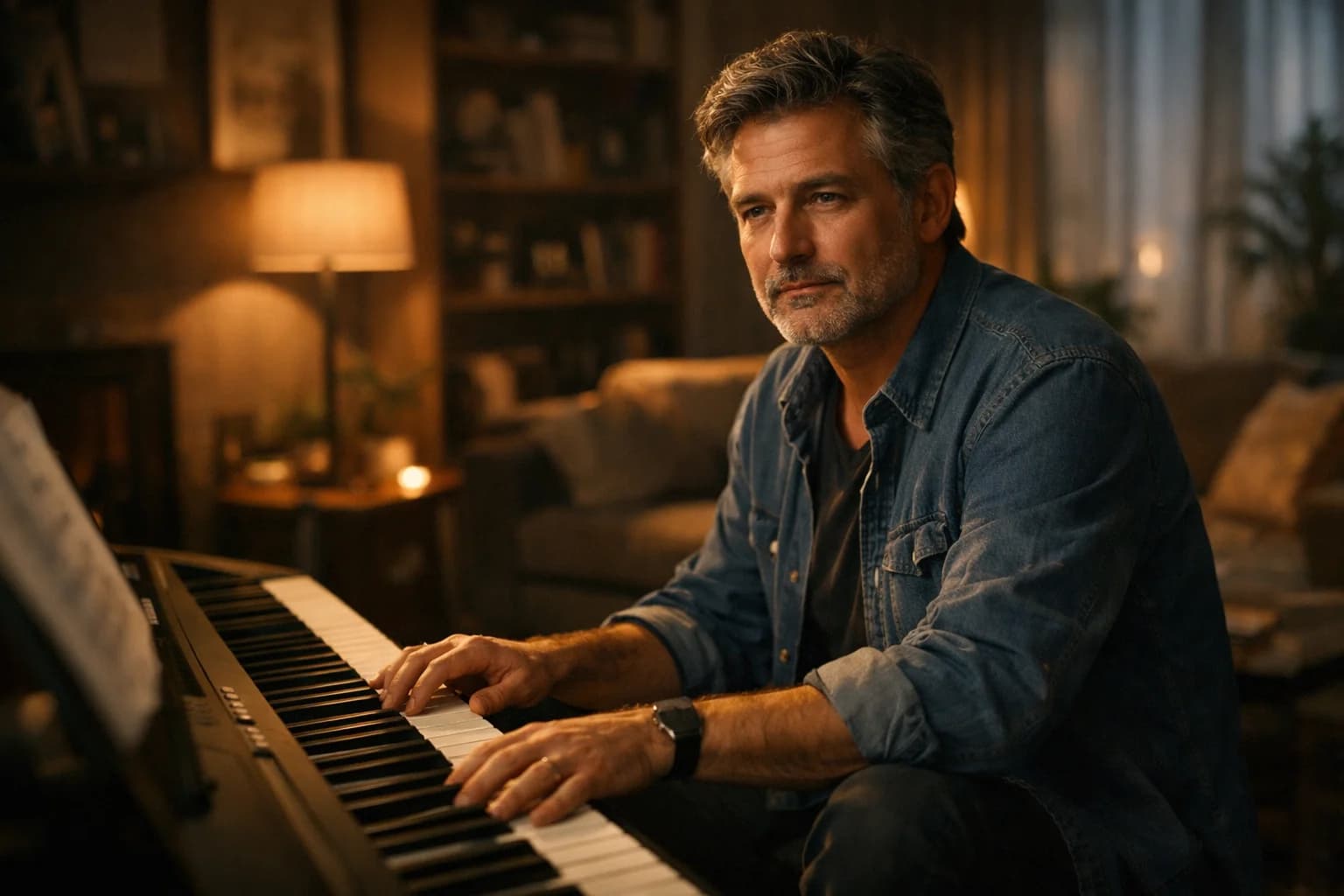
When you sit down, and place your fingers on the pianos keys, then you will immediately Notice two things you did Not Notice before:
your brain knows what it wants to do, and
your hands don’t agree.
If that’s your current reality, good. That friction is not proof you’re “too old.” It’s proof you’re doing something worth learning.
Learning Piano in Adulthood works when you stop chasing the fantasy of “natural talent” and start using what adults are actually good at: pattern recognition, planning, and sticking to a system.
Key truth: Adult brains remain capable of learning complex skills because neuroplasticity doesn’t “turn off.” It adapts. – University of Georgia
At Lotfi Piano, we’ve observed a clear pattern: adults who succeed don’t just “practice”—they leverage their mature cognitive strengths. This guide bypasses the generic advice and focuses on the science of cortical remapping (how your brain rewires itself for new skills). Whether you are in Dubai or anywhere in the world, the goal is the same: transforming frustration into fluent muscle memory.
Adults love to assume kids learn faster because they’re “sponges.” The reality is messier.
Adults often learn concepts faster (rhythm counting, chord logic, harmonic patterns).
Kids often learn habits faster (because someone else forces the routine).
Research on music learning in older adults shows measurable benefits in cognition, mood, and quality of life—including structured piano practice in seniors.
And broader medical/health reviews argue instrument learning can support cognitive functioning and stress reduction.
[irp posts=”37″]
So no—your age isn’t the wall. Your strategy is.
Let’s be blunt: adults have “unfair advantages” if they use them.
You understand why you’re doing it. You’re not trapped in a weekly lesson because your parents paid.
You can self-correct. You can listen, notice tension, adjust posture, and repeat with intention.
You can learn theory without fear. Chords and intervals aren’t “boring” when they explain your favorite songs.
You pick music for personal joy. That motivation is sticky—if you protect it.
This is why Learning to play the piano as an adult can move faster than you expect—when you stop copying child-based learning plans.
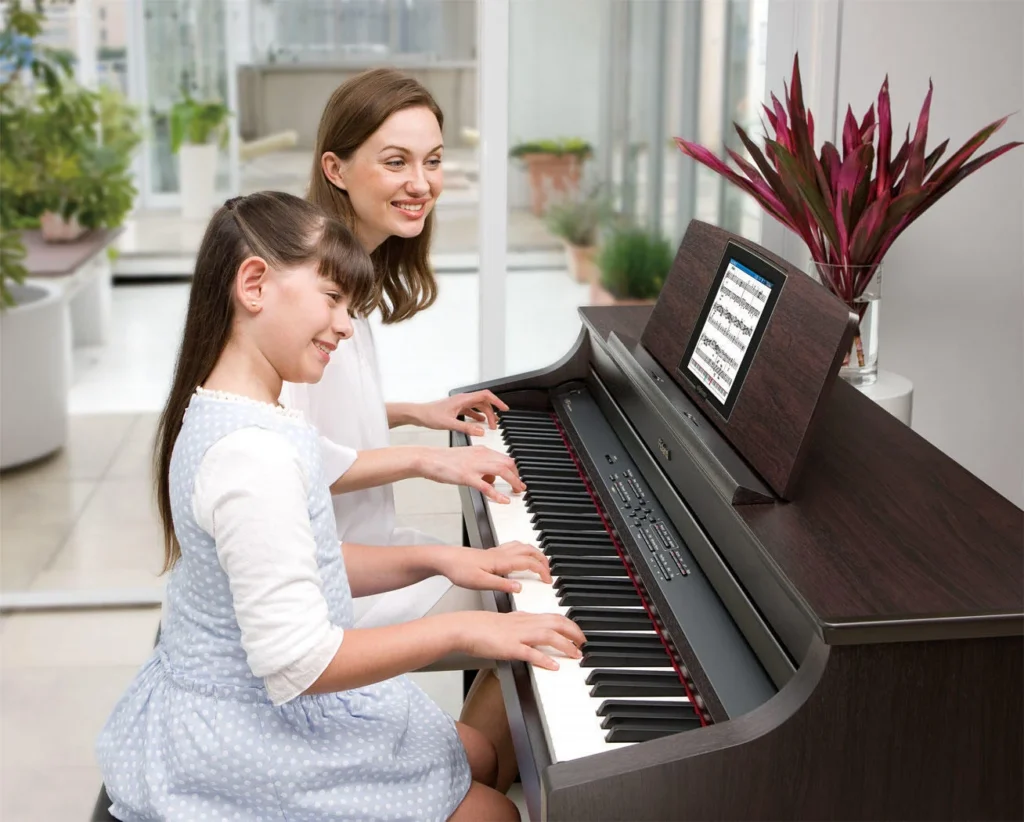
Before starting to say whether learning the piano is difficult or not, if you are planning to buy a piano in Dubai, you can also count on Lotfi Piano.
Is it difficult? Yes—but not for the reasons you think. It’s not about finger flexibility; it’s about cognitive load.
When you start, your brain is trying to manage three massive tasks simultaneously:
Adults find this “hard” because we are acutely aware of our mistakes. Children don’t care; adults do. The secret isn’t “practicing more”—it’s practicing with deliberate precision.
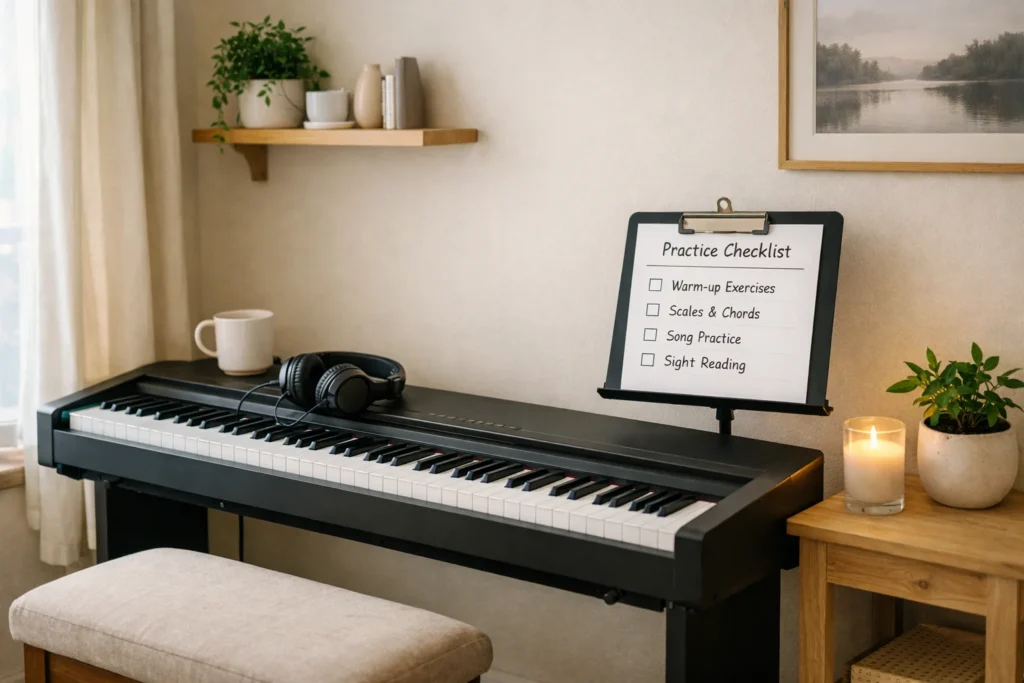
You don’t need a concert grand. You need an instrument that doesn’t fight you.
Minimum for a digital piano:
Why “Weighted Hammer Action” Matters: > As an adult, you need to build finger strength quickly. Cheap keyboards use springs, but a quality digital piano uses a Weighted Hammer Action mechanism. This mimics the physical lever system of an acoustic piano, where a felt hammer strikes a string. Without this resistance, you won’t develop the dexterity needed for dynamic control (playing soft vs. loud), and your transition to an acoustic instrument will feel impossible.
This removes the “space/cost barrier” and makes daily practice realistic.
Here’s your leverage point:
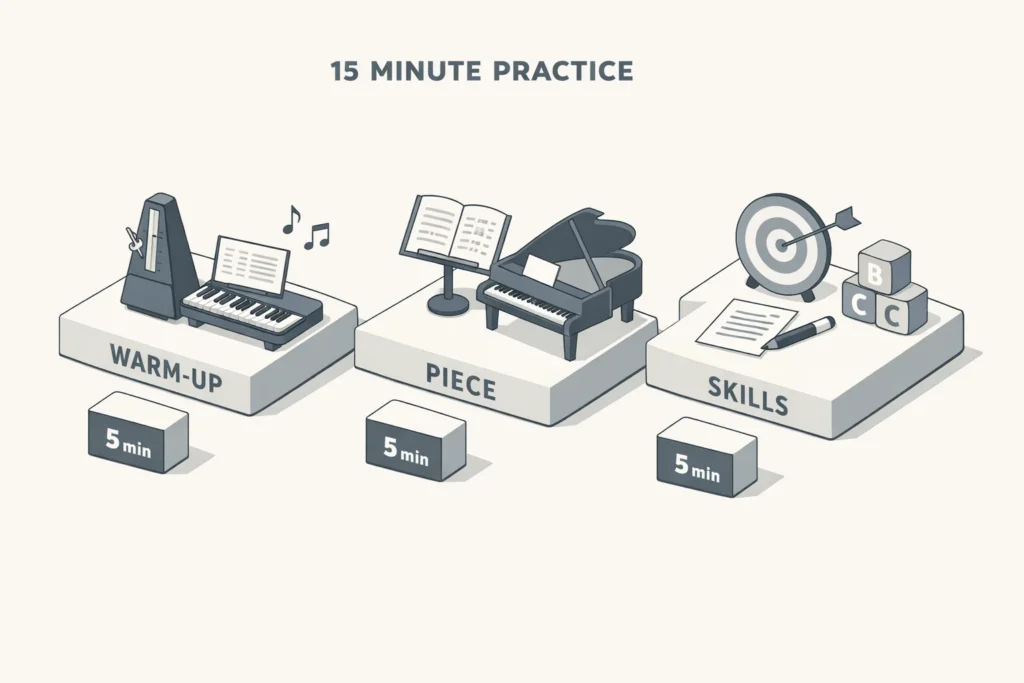
Daily 15 minutes done consistently beats a heroic 2-hour session once a week—because spaced practice builds retention better than massed practice.
A simple daily structure:
3 min: warm-up pattern (five-finger, simple scale fragment)
7 min: your current piece (tiny section only)
5 min: chords or rhythm drill
If you only have 15 minutes, you still win—because you showed up.
Adults fail when they rely on only one track (just apps, just songs, or just theory).
Use three lanes in parallel:
Method lane (progressive book/course): reading + technique
Music lane (songs you love): motivation + identity
Skill lane (micro drills): rhythm, chords, sight-reading, ear training
You can also refer to this pianodao.com article for more information on how to start learning the series.
This prevents boredom and prevents the “I can play one piece but can’t read anything” trap.
Most beginners practice by playing from the start and crashing at the same bar 20 times.
Do this instead:
Pick a 2–4 bar chunk
Play it slow (painfully slow)
Repeat until clean
Connect it to the next chunk
Only then increase tempo
This is the adult superpower: you can tolerate slow practice because you understand the goal.
Two tools:
Record yourself once a week (phone is enough)
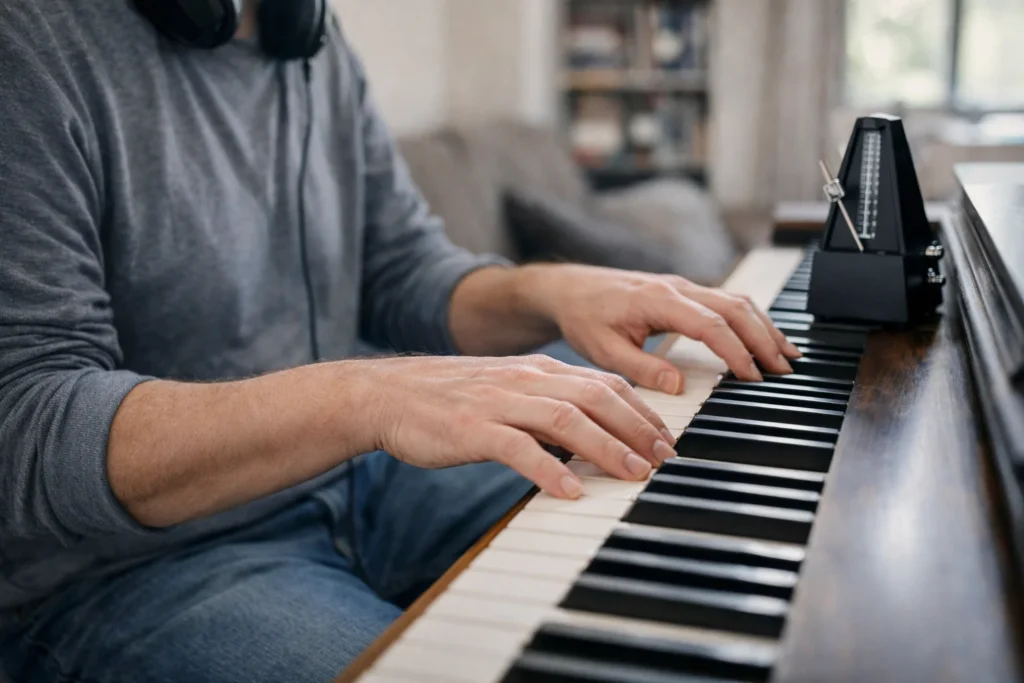
Use a metronome for rhythm honesty
Adults often “feel” like they’re steady when they’re not. Recording is a reality check—use it, don’t fear it.
Piano as a mental-health and brain investment
If your wrists lock and shoulders creep upward, progress slows and discomfort rises.
Most adults fail not because of their fingers, but because of their posture. Bench height is the foundation of technique. Your elbows should sit slightly higher than the keys, allowing your forearms to slope gently downward. If your bench is too low, you’ll instinctively shrug your shoulders to compensate, leading to the neck tension and “stiff fingers” that most beginners mistakenly blame on age.
It’s more than “normal”—it’s a global trend in lifelong learning. Adults now make up a significant percentage of piano students because they seek more than just a hobby; they want a creative outlet for stress management. Whether through an in-person mentor or a hybrid digital approach, professional guidance is the fastest way to solve technical bottlenecks like hand independence that DIY apps often ignore.
“FAST” doesn’t mean shortcuts. It means eliminating wasted effort.
Also: adults speed up when they stop trying to play like a child learning “perfectly.” You’re allowed to learn music you actually enjoy—early.
You do. You just need to redefine practice.
15 minutes daily = 91 hours per year.
That’s transformative.
Normal. Especially after 40.
Solutions:
Gentle warm-ups
Slow scales
Hand relaxation drills
Avoid tension
Finger flexibility improves over months—not days.
This is ego, not reality.
Nobody at the piano bench is judging you.
Most are too busy worrying about themselves.
What changes:
Warm-ups matter more.
Recovery matters more (short sessions, more frequent).
Your motivation is clearer (you’re doing it for you).
What doesn’t change:
You still improve through consistent, correctly-designed practice.
Studies involving older adults show piano learning can support well-being and cognition, reinforcing that starting later can still be meaningful and measurable.
Pick repertoire that builds patterns, not ego.
Simple five-finger melodies
“Hands separately” pieces that combine later
Basic chord drills (I–IV–V in easy keys)
Waltz-style left hand (bass + chord)
Simple arpeggio patterns
Easy lead-sheet playing (melody + chord symbols)
Pieces with phrasing and dynamics (soft/loud control)
Slow pieces where tone matters more than speed
Easy “theme” pieces you can polish and perform
Pro tip: keep one “showpiece” (motivation) and one “training piece” (skill). That balance keeps adults consistent.
Because they do one of these predictable things:
They expect linear progress (it isn’t).
They practice randomly, then blame motivation.
They pick music that’s too hard too soon.
They don’t get feedback, so mistakes become habits.
They miss two weeks, then decide they “failed.”
Teachers and adult-learning studios repeatedly report that inconsistency, unclear goals, and poor fit of lesson structure are major quitting drivers.
The fix is boring—and that’s why it works:
smaller goals
daily minimum practice
repertoire that matches skill
a plan you can maintain on your worst week
You’re not just learning notes. You’re training attention, coordination, and emotional regulation.
Research in older adults links piano learning with improved mood and quality of life and reduced depressive symptoms in some contexts.
Medical perspectives also argue that learning an instrument can support cognitive functioning and reduce stress.
So yes—this can be “self-development” in the most literal sense: you’re building a better-functioning you.
The biggest obstacle to learning piano at 40 or 60 isn’t arthritis—it’s ego. Adults expect to sound like Chopin in week three. When they don’t, they quit.
To succeed, you must adopt a “Scientist Mindset.” View every wrong note not as a failure, but as data. If a transition is messy, it’s not because you’re “not musical”—it’s because the neural pathway hasn’t been insulated yet. Slow down, shorten the loop, and let the biology of learning do the heavy lifting.
If you want Learning Piano as an Adult to stick, stop romanticizing it and star`t systemizing it.
Do this today:
Set up the instrument so it’s easy to access.
Choose one method + one fun piece.
Commit to 15 minutes daily for 14 days.
That’s it. Not because it’s easy—because it’s the only plan that survives real adult life.
[rank_math_rich_snippet id=”s-f27a2f83-e561-49d3-b5e7-aefca411f09c”]
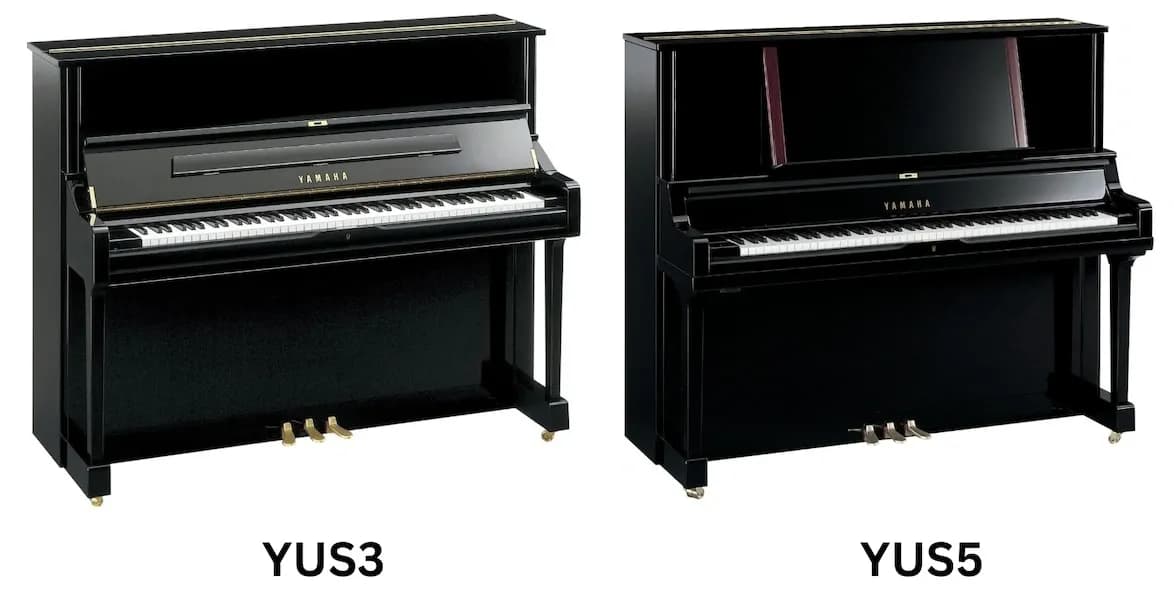
From our showroom
Hand-picked models related to this article — explore what's in our showroom.
Keep reading